
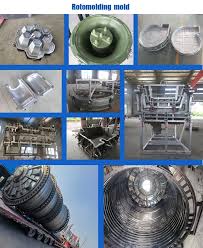
What is rotational molding, and why is it preferred for precision plastic parts?
Rotational molding, also known as rotomolding, is a manufacturing process that produces hollow, seamless plastic components. Unlike injection molding, it allows for consistent wall thickness, minimal waste, and intricate design possibilities. Industry statistics indicate that products manufactured through rotational molding have up to 30% fewer defects compared to conventional molding techniques, making it a trusted choice for high-precision parts.
Which industries benefit most from precision rotomolding?
Precision Rotational Molding serves a wide spectrum of industries, including automotive, medical devices, aerospace, and industrial equipment. Data from manufacturing reports suggest that over 45% of high-performance industrial components now utilize rotomolded parts due to their durability and design flexibility. Sectors requiring tight tolerances, chemical resistance, or complex geometries find rotational molding particularly advantageous.
How do experts ensure dimensional accuracy in rotomolded parts?
Achieving precision in rotomolded parts relies on advanced mold design, precise temperature control, and high-quality raw materials. Experts employ computer-aided design (CAD) and simulation software to predict material behavior and minimize deviations. Recent industry surveys indicate that facilities implementing digital mold simulation have improved first-pass yield by nearly 25%, highlighting the role of technology in maintaining consistent quality.
What materials are commonly used for precision rotomolding?
Polyethylene remains the most widely used material for rotational molding, valued for its chemical resistance, impact strength, and versatility. However, specialized engineering polymers, including polypropylene and nylon blends, are gaining traction for high-precision applications. Market research reveals that the adoption of advanced polymers for rotomolding has increased by 18% over the last five years, driven by demand for lightweight yet robust components.
Can rotational molding accommodate complex geometries?
Yes, one of the major advantages of rotational molding is its ability to produce complex shapes without compromising structural integrity. Hollow parts with internal features, multi-chamber designs, or thick-to-thin wall transitions can be manufactured with minimal post-processing. Studies show that design flexibility is a key factor driving a 22% growth in custom rotomolding orders annually.
Why choose rotational molding over other manufacturing methods?
Rotational molding offers multiple advantages: lower tooling costs, consistent wall thickness, and minimal waste. For precision parts, it reduces post-production finishing, accelerates prototyping, and enables production of durable, long-lasting components. Industry statistics reveal that companies using rotational molding report a 15-20% reduction in production costs for medium-volume parts compared to injection molding.
How do experts ensure repeatability and reliability?
Precision rotomolding relies on repeatable processes and stringent quality control. Techniques such as in-line inspection, laser scanning, and destructive testing are employed to verify tolerances and structural integrity. According to recent manufacturing quality reports, facilities integrating real-time monitoring and inspection systems achieve up to 98% defect-free production rates.
Rotational molding continues to evolve as a preferred solution for manufacturers seeking precision, consistency, and design versatility in plastic parts. With a combination of material innovation, technological integration, and expert craftsmanship, rotomolding remains at the forefront of precision plastic manufacturing.
